


Empowering
Why UAE Businesses Are Consolidating CRM, Finance, Inventory, and Import Operations into a Unified ERP — And Why Zoho Fits This Reality
Introduction: In the UAE, Growth and Imports Stress Systems First
The UAE is a trade-driven economy. For most businesses—whether in trading, retail, manufacturing, logistics, or e-commerce—a significant portion of goods is imported, not locally sourced.
As companies scale, the real complexity does not come from sales volume alone. It comes from:
- Managing overseas suppliers
- Tracking import costs and landed cost
- Handling bonded and non-bonded warehouses
- Staying VAT-compliant across import, storage, and sale
Most UAE businesses do not fail because of weak demand.
They struggle because imports, inventory, finance, and compliance live in separate systems.
This is why ERP adoption in the UAE is accelerating rapidly.
According to Grand View Research, the UAE ERP market is expected to reach USD 752.2 million by 2030, growing at a 15.5% CAGR. This reflects a shift toward unified, cloud-based ERP platforms that bring control to import-heavy, fast-scaling operations.
WHAT: What Is Driving ERP Consolidation in the UAE?
The UAE Is an Import-Led Market
For many UAE businesses:
- 40–80% of goods are imported
- Suppliers are international
- Lead times are long
- Costs fluctuate due to freight, duties, and currency
Without ERP, businesses struggle to answer basic questions:
- Which suppliers account for most imports?
- How much inventory is sitting in warehouses vs in transit?
- What is the true landed cost of goods?
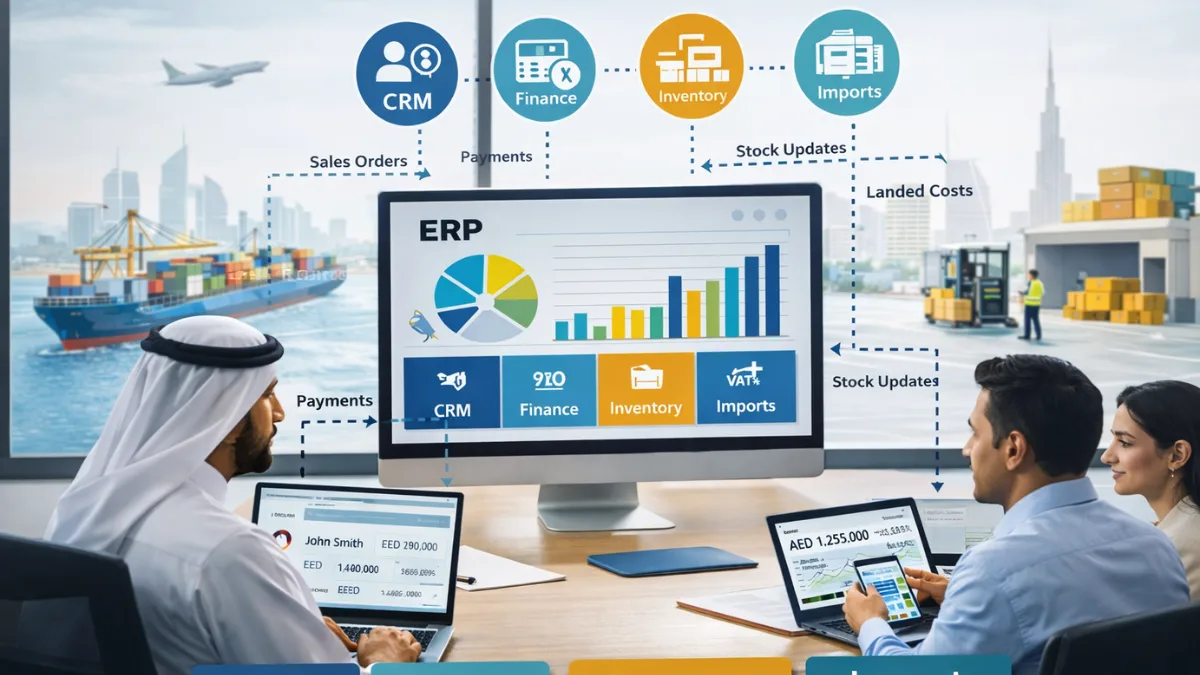
ERP consolidation allows businesses to see imports, inventory, and finance as one flow, not disconnected activities.
Fast-Growing Industries Need Structure
Industries such as e-commerce, retail, logistics, construction, and manufacturing scale rapidly in the UAE.
ERP ensures that:
- Imports align with demand
- Warehouses do not become black boxes
- Finance reflects true profitability
Growth without system discipline leads to hidden losses.
Multi-Entity, Multi-Warehouse Operations Are Common
Many UAE organisations operate across:
- Free zone and mainland entities
- Multiple warehouses
- Cross-border trading setups
ERP consolidation enables entity-wise control with group-level visibility.
WHY: Why Disconnected Systems Fail Import-Heavy UAE Businesses
Import Costs Are Often Invisible Without ERP
When imports are managed outside ERP:
- Freight, customs, and handling costs are tracked manually
- Landed cost accuracy suffers
- Margins appear healthier than they really are
ERP ensures import costs are captured, allocated, and visible.
Warehouses Become Risk Zones Without System Control
High imports naturally lead to warehousing complexity:
- Stock ageing
- Batch tracking issues
- Inventory mismatch with sales
Without ERP-driven warehouse management, businesses face:
- Excess stock
- Stock-outs
- Write-offs
VAT Compliance Gets Complicated with Imports
Import VAT, reclaim eligibility, and audit documentation must align with:
- Purchase records
- Inventory movement
- Sales transactions
Manual tracking increases audit exposure and reconciliation effort.
Multicultural, Expat-Led Teams Need Standard Processes
UAE teams are diverse and distributed. ERP provides:
- Role-based access
- Standard workflows
- Bilingual usability (Arabic and English)
This reduces dependency on individual knowledge.
WHY ZOHO: Why Zoho Fits the UAE’s Import-Heavy Business Model
Many UAE businesses choose Zoho because it delivers unified ERP capability without enterprise heaviness.
Zoho is particularly suited for UAE organisations that:
- Import a large portion of goods
- Operate multiple warehouses
- Need VAT-ready finance
- Want fast adoption and predictable cost
Zoho’s strength lies in tight integration between finance, inventory, CRM, purchasing, and analytics—critical for import-led operations.
HOW: How Zoho Supports Imports, Warehousing, and Compliance in the UAE
Supplier and Import Visibility
Zoho allows businesses to:
- Analyse supplier-wise import percentage
- Track overseas vendors separately
- Monitor purchase cycles and lead times
This helps leadership understand import dependency and risk exposure.
Inventory and Warehouse Management
Zoho supports:
- Multi-warehouse inventory
- Stock movement tracking
- Batch and serial control
- Inventory ageing analysis
Warehouses stop being storage spaces and become controlled assets.
Landed Cost and Cost Accuracy
Zoho helps allocate:
- Freight and handling charges
- Import-related costs
- Purchase-linked expenses
This ensures inventory valuation and profitability reflect reality.
VAT-Ready Finance for Imports
Zoho supports:
- VAT-compliant purchase and sales records
- Clear audit trails
- Consistent treatment of import-related VAT
Finance teams gain confidence during audits and inspections.
CRM to Order to Inventory Flow
With Zoho:
- Sales demand informs purchasing
- Inventory availability is visible to sales
- Billing aligns with stock movement
This reduces over-ordering and improves cash flow.
Analytics and Reporting
Zoho dashboards provide:
- Import vs local procurement insights
- Inventory turnover visibility
- Warehouse performance metrics
- Real-time profitability
Decisions move from instinct to data.
Cloud ERP in the UAE: Why Zoho Works Well
Zoho’s cloud-first architecture offers:
- Faster implementation
- Lower infrastructure cost
- Secure remote access
- Easy scaling as imports grow
This fits UAE businesses that need speed without complexity.
FAQs: Real Questions UAE Import-Led Businesses Ask
1. Is Zoho suitable for businesses with high import volumes?
Yes. Zoho supports overseas suppliers, purchase workflows, inventory tracking, and landed cost allocation, making it suitable for import-heavy operations.
2. Can Zoho handle multiple warehouses and stock movement?
Yes. Zoho provides multi-warehouse visibility, stock transfers, and inventory tracking across locations.
3. How does Zoho help during VAT audits related to imports?
Zoho maintains structured records linking purchases, inventory movement, and sales, making audit reviews simpler and faster.
4. Is Zoho implementation complex for trading businesses?
Zoho allows phased implementation—starting with finance and inventory, then extending to CRM and analytics—reducing disruption.
5. Will Zoho scale as the business grows?
Yes. Zoho supports multi-entity structures, growing transaction volumes, and expanding warehouse networks.
Final Takeaway
In the UAE, growth is closely tied to imports, warehousing, and compliance.
When these operate outside ERP, risk accumulates silently.
Unified ERP is no longer about digitisation.
It is about seeing imports, inventory, finance, and sales as one system.
Zoho enables UAE businesses to:
- Control import-led complexity
- Manage warehouses with accuracy
- Stay VAT-compliant
- Scale without operational chaos
For many UAE organisations, choosing Zoho is not about choosing a lighter ERP.
It is about choosing a practical, scalable system built for how the UAE actually operates.
.webp)
.webp)



.svg)