


Empowering
Why Indian Companies Are Moving from Payroll Tracking to Workforce Governance with Zoho
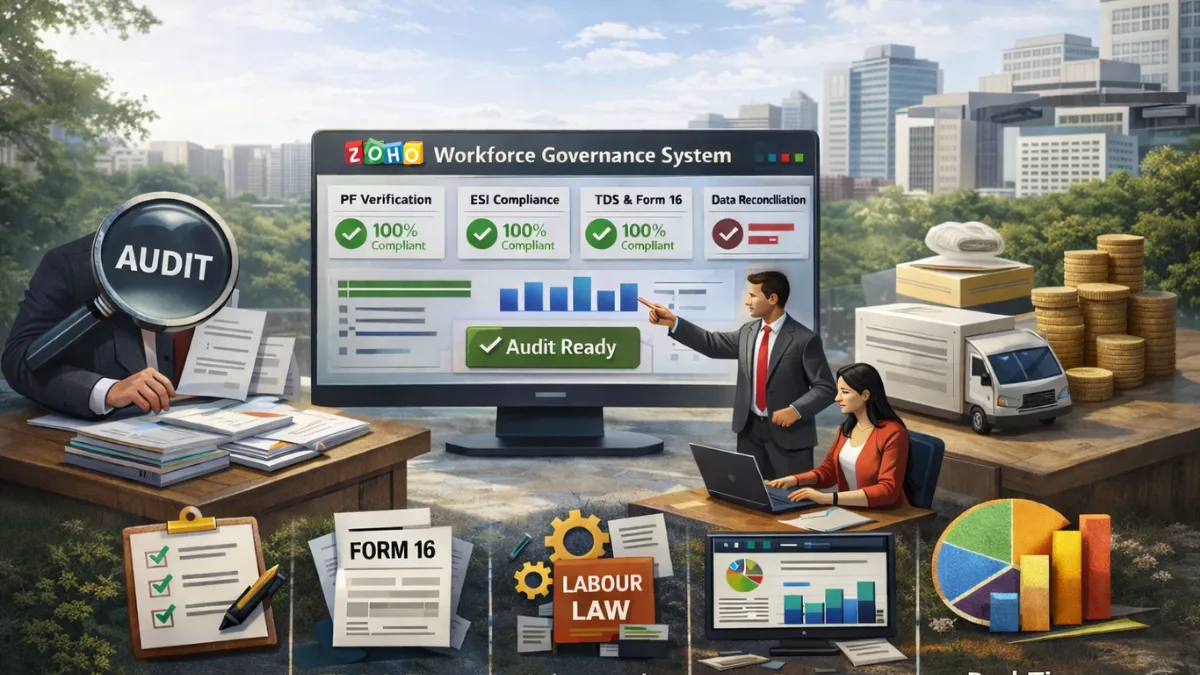
Introduction: In 2026, Payroll Compliance in India Is No Longer a Task — It’s a System Capability
Statutory compliance in India has crossed a fundamental inflection point.
What was earlier managed through calendars, consultants, and post-facto corrections is now enforced through data-driven scrutiny, portal-level reconciliations, and automated exception detection. Payroll, once treated as a routine HR activity, has become a financial, legal, and reputational risk area.
With the rollout of consolidated labour codes, restructuring of wage definitions, tightening of PF and ESI enforcement, growing use of contractors and gig workers, and increasing focus on employee data protection, compliance failures now scale faster than organisations can manually respond.
This is why Indian companies are rethinking payroll—not as a monthly activity, but as a governed system that must stand up to audits, inspections, and board scrutiny.
This Statutory Compliance Calendar 2026 serves as a practical reference for HR, payroll, finance, and compliance teams. More importantly, it explains why compliance calendars alone are no longer sufficient—and why ZOHO platforms, particularly those built for Indian regulatory realities, are becoming central to workforce governance.
WHAT: What the 2026 Annual Payroll Compliance Checklist Covers
1. Annual Provident Fund (PF) Verification and Returns
PF compliance today goes far beyond depositing monthly challans.
Annual PF verification is critical to ensure:
- Employee and employer contributions are correctly computed
- Deposits reconcile with EPFO records
- UANs are accurately mapped
- Wage definitions and contribution ceilings are correctly applied
This process helps uncover hidden risks such as:
- Incorrect basic salary calculations
- PF applicability errors
- Mismatches between payroll data and EPFO records
If discovered during audits, these gaps often result in retrospective liabilities, penalties, and reputational damage.
2. Annual Employees’ State Insurance (ESI) Compliance Review
ESI compliance requires accuracy across:
- Wage eligibility thresholds
- Contribution calculations
- Continuity of employee coverage
Annual ESI validation ensures:
- Eligible employees are not wrongly excluded
- Contributions are neither over- nor under-deducted
- Employee benefit continuity is protected
Given frequent workforce movement, this annual review has become essential for Indian organisations.
3. Submission of TDS Form 24Q and Issuance of Form 16
Form 24Q consolidates quarterly TDS on salary, while Form 16 issued in Q4 becomes the employee’s definitive tax record.
Errors here directly result in:
- Income tax notices
- Penalties and interest
- Employee dissatisfaction due to Form 26AS mismatches
Precision is non-negotiable because payroll data flows directly into individual tax filings.
4. Payroll and Financial Data Reconciliation
One of the most common audit observations in India is misalignment between payroll records and financial books.
Annual reconciliation ensures:
- Salary payouts match bank transactions
- Statutory deductions align with ledger balances
- Reimbursements and allowances are correctly accounted
This step prevents financial leakage and audit qualifications.
5. Bonus and Gratuity Validation
Under the Payment of Bonus Act and Payment of Gratuity Act, organisations must ensure:
- Correct eligibility determination
- Accurate calculation based on tenure and wage definitions
- Adherence to statutory ceilings
With wage structures evolving under labour codes, annual validation is essential to avoid disputes during audits or employee exits.
6. Alignment with New Labour Code Notifications
The Ministry of Labour & Employment has introduced the most significant labour reforms in decades, impacting:
- Wage structures
- Contribution calculations
- Benefit definitions
Delayed alignment leads to inconsistencies, rework, and compliance gaps—especially in multi-location organisations.
WHY: Why Compliance Calendars and Outsourcing Are No Longer Enough
Compliance Is Now System-Verified, Not Document-Reviewed
Indian regulators increasingly rely on:
- Portal-level data
- Cross-system reconciliation
- Automated exception flags
Static calendars and manual trackers cannot meet this level of scrutiny.
Penalties Are Real and Escalating
Non-compliance can result in:
- Fines up to ₹3 lakh
- 12% interest on delayed PF/ESI deposits
- In extreme cases, imprisonment up to 3 years
These are active enforcement outcomes, not theoretical risks.
Outsourcing Does Not Remove Accountability
While payroll bureaus, consultants, and Employer of Record (EoR) partners are widely used, legal responsibility remains with the employer.
Without internal system control, organisations remain exposed even when operations are outsourced.
Payroll Is Now a Board-Level Risk Topic
Boards and CFOs increasingly ask:
- Are we compliant across all states and locations?
- What is our statutory exposure?
- Can we defend our payroll data during an inspection?
Without ZOHO-level visibility, these questions cannot be answered with confidence.
HOW: How Zoho Transforms Payroll Compliance into Workforce Governance
This is where Zoho plays a defining role in the Indian context.
Zoho does not approach payroll as a standalone calculation engine. It positions payroll as part of a broader workforce governance framework—where HR, finance, compliance, and data control operate as one system.
One Unified System for HR, Payroll, and Finance
Zoho integrates:
- Attendance and leave management
- Payroll processing
- Statutory deductions (PF, ESI, PT, LWF)
- Accounting entries and cost centres
This ensures that:
- Payroll costs are reflected accurately in financials
- Statutory deductions are traceable end-to-end
- Reconciliation becomes systematic, not manual
Payroll stops being an isolated HR process and becomes part of the organisation’s financial spine.
Compliance Embedded, Not Remembered
Zoho embeds statutory logic directly into payroll workflows:
- Statutory deductions are applied consistently
- Thresholds and eligibility rules are system-driven
- Changes are tracked and auditable
Instead of relying on reminders or individual knowledge, compliance becomes a repeatable system outcome.
Audit-Ready by Design
Zoho maintains:
- Statutory registers
- Employee wage and tenure history
- Approval trails and change logs
During inspections or audits, organisations can present structured data with confidence—rather than scrambling to reconstruct records.
Handling Labour Code Changes Without Chaos
As labour codes evolve, Zoho allows organisations to:
- Centrally update wage structures
- Automatically reflect changes across PF, ESI, gratuity, and bonus calculations
- Assess financial and compliance impact before rollout
This significantly reduces rework and downstream errors.
Workforce Cost and Compliance Analytics for Leadership
Zoho enables leadership to view:
- Department-wise and location-wise payroll cost
- Statutory liability exposure
- Trends in workforce expenses
Payroll shifts from a processing function to a decision-support and risk-management capability.
Secure, Governed Employee Data
Payroll data is among the most sensitive information an organisation holds. Zoho enforces:
- Role-based access controls
- Limited data visibility
- Strong audit trails
This supports India’s increasing focus on data protection and employee privacy.
FAQs: Questions Indian Organisations Are Actively Asking
Is this compliance checklist applicable to all Indian companies?
Applicability varies by state, industry, and employee strength, but most organisations will be impacted by a majority of these requirements.
Can payroll compliance be managed without ZOHO?
It can—but at increasing risk. Manual systems struggle to provide accuracy, traceability, and audit readiness as enforcement becomes automated.
Does Zoho replace payroll consultants or EoR partners?
No. Zoho provides system-level governance and data integrity. Consultants and EoR partners provide interpretation and execution support..
How often should payroll audits be conducted?
At least annually. Many organisations now conduct quarterly internal reviews using ZOHO data to reduce exposure.
Is Zoho suitable for growing, multi-state organisations?
Yes. Zoho supports multi-location compliance, evolving workforce models, and scaling headcount without breaking governance.
Final Takeaway
In 2026, statutory compliance in India is no longer about remembering deadlines.
It is about demonstrating compliance through systems.
A compliance calendar tells you what needs to be done.
An ZOHO platform like Zoho ensures it is done correctly, consistently, and defensibly.
As labour laws consolidate, enforcement tightens, and workforce models evolve, Indian organisations must move from calendar-driven payroll to system-driven workforce governance.
That shift is no longer optional.
It is the cost of operating responsibly in India’s next compliance era.




.svg)