


Empowering
Why Indian Businesses Outgrowing Tally, NAV, AX, SAP ECC & Custom ERPs Are Moving to Microsoft Dynamics 365 Finance & Operations
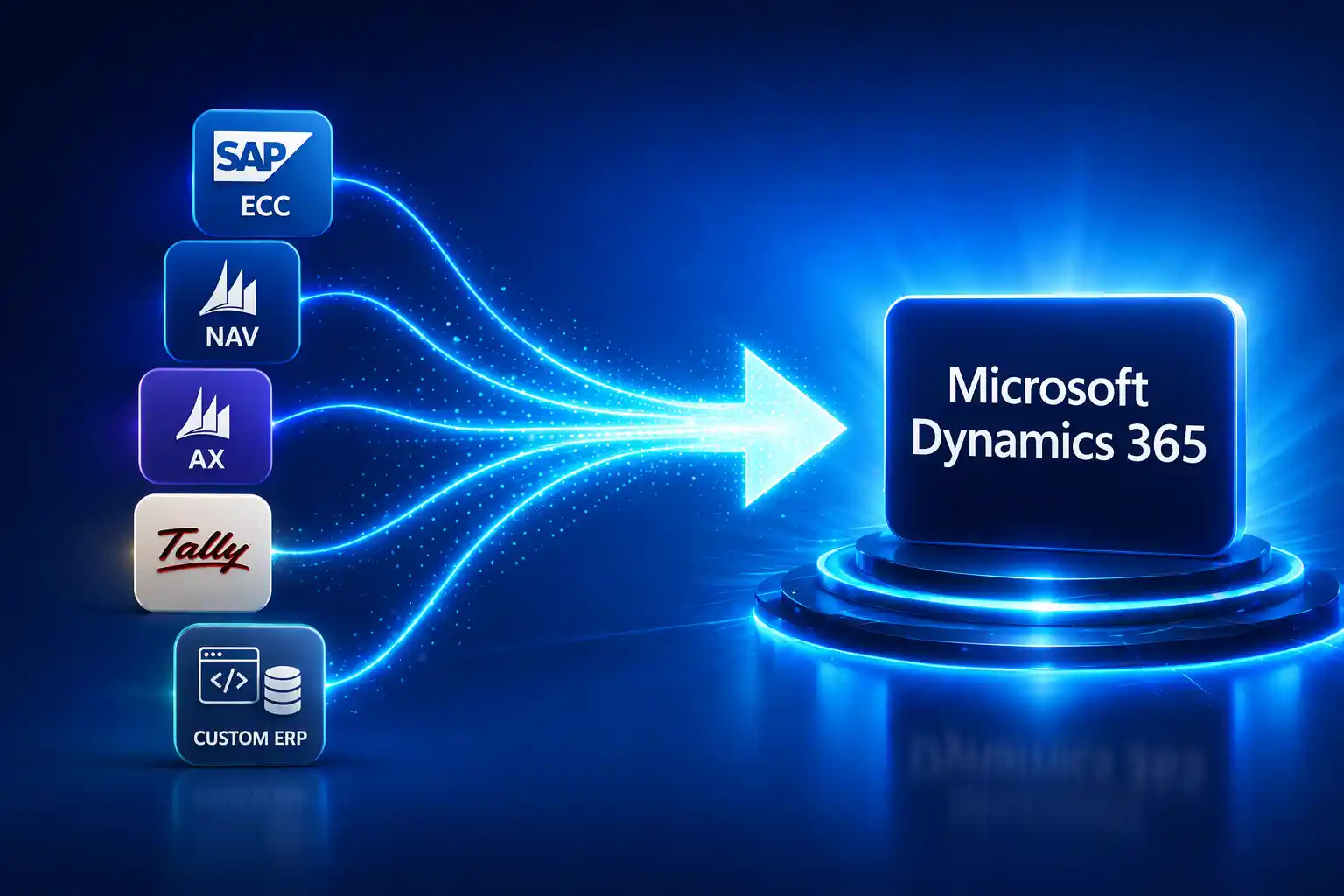
Introduction: The Indian Market Has Changed Faster Than Legacy ERP Systems
India is entering a new phase of business growth.
Across manufacturing, retail, trading, infrastructure, pharma, logistics, renewable energy, and consumer sectors, businesses are scaling faster than they were five years ago. Capacity expansion is rising. New industrial corridors are opening. Exports are increasing in several categories. Private investment is returning. Mid-sized Indian companies are becoming national players, and national players are becoming global contenders.
At the same time, the operating environment has become more demanding.
Indian businesses are now managing:
- GST-led compliance maturity
- e-Invoicing and digital tax controls
- faster working capital cycles
- tighter audit expectations
- rising customer service standards
- multi-state distribution complexity
- import dependency risks
- currency volatility
- commodity price movement
- increasing pressure to digitise decision-making
This means growth today is not just about selling more.
It is about scaling with control.
And that is exactly where many businesses are discovering that their older ERP systems are no longer aligned with current reality.
Systems like:
- TallyPrime
- older Microsoft Dynamics NAV
- legacy Microsoft Dynamics AX
- SAP ECC
- heavily customised in-house ERPs
were often right for an earlier phase of growth.
But today, many Indian CFOs, CIOs, and CTOs are asking a sharper question:
Has our business become more advanced than our ERP?
Increasingly, the answer is yes.
That is why more growth-focused Indian organisations are moving toward Microsoft Dynamics 365 Finance and Microsoft Dynamics 365 Supply Chain Management, commonly referred to as Dynamics 365 Finance & Operations (D365 F&O).
WHAT WE ARE TALKING ABOUT: When ERP Still Works, But No Longer Works for Growth
Most ERP systems do not fail dramatically.
They fail quietly.
- Transactions continue.
- Invoices get generated.
- Reports are available.
- Users log in every day.
Yet the business starts feeling heavier than it should.
- Simple decisions take longer.
- Different departments rely on different numbers.
- Excel becomes the unofficial reporting layer.
- Month-end feels like a recurring project.
- Every new plant, warehouse, product line, or business entity creates operational strain.
This is not usually a people issue.
It is often a sign that the business has outgrown the architecture, flexibility, and scalability of its current ERP system.
That moment is common in India today because many companies have grown rapidly, while their systems have not evolved at the same pace.
WHY THIS MATTERS NOW: India’s Growth Needs More Robust ERP Foundations
1. Growth in India Is Becoming Multi-Dimensional
Earlier, a company may have operated from one city or one state.
Today, many Indian businesses manage:
- multiple warehouses
- multiple GST registrations
- distributor networks across states
- exports to GCC, Africa, Europe, or Southeast Asia
- ecommerce plus offline channels
- multiple brands or verticals
This complexity requires structured systems, not patched processes.
2. Compliance Is Becoming Real-Time
India’s regulatory environment has changed significantly.
Businesses now need stronger controls around:
- GST reporting accuracy
- e-Invoicing
- e-Way Bills
- TDS and payroll governance
- audit readiness
- digital records management
- data privacy expectations
Legacy systems often detect problems after they occur.
Modern ERP systems help prevent them before they happen.
For CFOs, this reduces financial and audit risk.
For CIOs, it strengthens governance.
For management, it reduces firefighting.
3. Economic and Political Changes Require Agility
Indian businesses are affected by:
- import restrictions
- commodity price volatility
- freight cost spikes
- exchange rate movement
- changing tax interpretations
- global geopolitical disruptions
When leadership gets visibility after month-end, decisions are already delayed.
Modern businesses need live insight into:
- margins
- inventory exposure
- receivables risk
- plant performance
- procurement cost shifts
4. Custom ERPs Often Become Hidden Liabilities
Many Indian businesses invested in custom ERP systems years ago.
These systems solved real needs initially. But over time, they often become dependent on:
- one internal developer
- outdated architecture
- poor documentation
- fragile integrations
- slow change cycles
That creates strategic dependency risk at the exact moment the business needs agility.
INDUSTRY IMPACT: Where Older ERP Systems Start Showing Limits
Manufacturing
Manufacturers need:
- BOM control
- production planning
- batch / lot traceability
- quality processes
- plant-wise visibility
- procurement control
When scale increases, older systems often struggle.
FMCG / Distribution
Fast-moving businesses need:
- distributor visibility
- stock ageing control
- secondary sales insights
- replenishment speed
- channel profitability
Excel-based reporting slows response time.
Commodity / Trading Businesses
These businesses need:
- contract management
- landed cost visibility
- forex risk awareness
- inventory accuracy
- deal-level profitability
Traditional accounting-led systems rarely manage this well.
Retail / Omnichannel
Retailers need:
- central inventory visibility
- store replenishment
- finance integration
- omnichannel controls
- real-time profitability views
Disconnected systems create leakage.
Projects / Infra / EPC
They need:
- project costing
- procurement controls
- billing milestones
- retention tracking
- budget vs actual monitoring
Without integrated ERP, overruns are often discovered too late.
HOW MICROSOFT DYNAMICS 365 FINANCE & OPERATIONS SOLVES THIS
One Platform, One Truth
Dynamics 365 unifies finance, procurement, manufacturing, warehousing, supply chain, and operations in one connected environment.
This means:
- fewer reconciliations
- better accountability
- faster decisions
- stronger control
For CFOs, this means trusted numbers.
Real-Time Visibility Instead of Historical Reporting
Leadership can monitor:
- margin by customer / product / region
- live inventory positions
- delayed receivables
- procurement variances
- production bottlenecks
Meetings move from explanation to action.
Built for Scale
Dynamics supports:
- multi-company structures
- multi-location operations
- intercompany flows
- higher transaction volumes
- phased expansion
This is critical for Indian groups growing rapidly.
Agile During Policy and Market Changes
When tax rules, operating models, or business structures change, Dynamics supports configuration-led adaptability and structured extensibility.
That matters in a market like India where conditions change quickly.
Better Scope for Controlled Customisation
Indian businesses often need industry-specific workflows.
Dynamics offers a stronger long-term balance between:
- standard platform strength
- upgradeability
- controlled customisation
- automation opportunities
This is where many older systems fail.
Deep Microsoft Ecosystem Advantage
Dynamics works naturally with:
- Microsoft Excel
- Microsoft Outlook
- Microsoft Teams
- Microsoft Power BI
- Microsoft Power Apps
- Microsoft Copilot
That improves adoption because users stay in tools they already know.
WHAT SMART INDIAN BUSINESSES DO FIRST: ROADMAP BEFORE SOFTWARE
The best ERP journeys do not begin with demos.
They begin with clarity.
Phase 1: Identify Growth Friction
Where is the current system slowing the business?
- reporting trust
- finance close
- inventory accuracy
- compliance effort
- process delays
Phase 2: Prioritise Business Outcomes
What matters first?
- stronger finance control
- better planning
- faster reporting
- plant visibility
- scalable governance
Phase 3: Move in Phases
Well-run organisations modernise in stages, not chaos.
Phase 4: Focus on Adoption
ERP value comes from behaviour change, not software purchase.
FAQs
1. Why are Indian businesses moving from Tally, NAV, AX, SAP ECC, and custom ERP systems to Microsoft Dynamics 365?
As businesses scale, legacy systems often struggle with multi-location operations, real-time reporting, compliance complexity, and growing process customisation. Microsoft Dynamics 365 offers a modern ERP platform built for scalability, stronger controls, faster decisions, and long-term growth.
2. Can Microsoft Dynamics 365 handle multiple companies, branches, GST registrations, and group entities?
Yes. Microsoft Dynamics 365 is designed for multi-company and multi-location businesses. It supports multiple legal entities, GST registrations, intercompany transactions, and consolidated reporting—ideal for growing Indian business groups.
3. How does Microsoft Dynamics 365 help with GST, e-Invoicing, and financial compliance in India?
Microsoft Dynamics 365 helps create stronger transaction controls, approval workflows, audit trails, and cleaner reporting processes. This improves readiness for GST compliance, e-Invoicing, tax reporting, and statutory audits.
4. Is Microsoft Dynamics 365 suitable for manufacturing and distribution companies in India?
Absolutely. It supports production planning, procurement, inventory control, warehouse management, distributor operations, demand planning, and real-time business visibility—making it highly relevant for Indian manufacturing and trading businesses.
5. Why should Indian businesses choose BaffleSol for Microsoft Dynamics 365 implementation?
BaffleSol combines Microsoft Dynamics expertise with practical understanding of Indian business realities such as compliance pressure, multi-location growth, manufacturing complexity, and cost-sensitive expansion. We focus on phased, business-first ERP transformation with measurable outcomes.
HOW BAFFLESOL HELPS INDIAN BUSINESSES MODERNISE WITH CONFIDENCE
Many ERP partners focus on software deployment.
BaffleSol focuses on business outcomes.
We help Indian businesses:
- assess whether they have outgrown Tally, NAV, AX, SAP ECC, or custom ERP
- build practical transformation roadmaps
- implement Dynamics 365 in phased, low-disruption models
- improve reporting, controls, and decision visibility
- integrate Power BI, automation, and AI productivity layers
- align ERP design with Indian operating realities
We understand:
- promoter-led speed
- compliance pressure
- execution bandwidth constraints
- cost sensitivity with growth ambition
- need for practical ROI, not theory
That is why our approach is grounded, transparent, and execution-led.
Final Thought
Indian businesses are entering a more competitive and more complex decade.
The winners will not just be those who grow faster.
They will be those who scale with control, clarity, and agility.
Businesses do not leave legacy ERP because they want a new system.
They move because they want:
- faster answers
- stronger controls
- cleaner reporting
- scalable operations
- better adaptability to change
Microsoft Dynamics 365 Finance & Operations provides the platform.
BaffleSol helps Indian businesses turn that platform into measurable business advantage.
.png)


.svg)