


Empowering
Why Dynamics 365 Dual-Write Matters for Connected Manufacturing: From Aerospace and Robotics to Ethanol and Biofuel
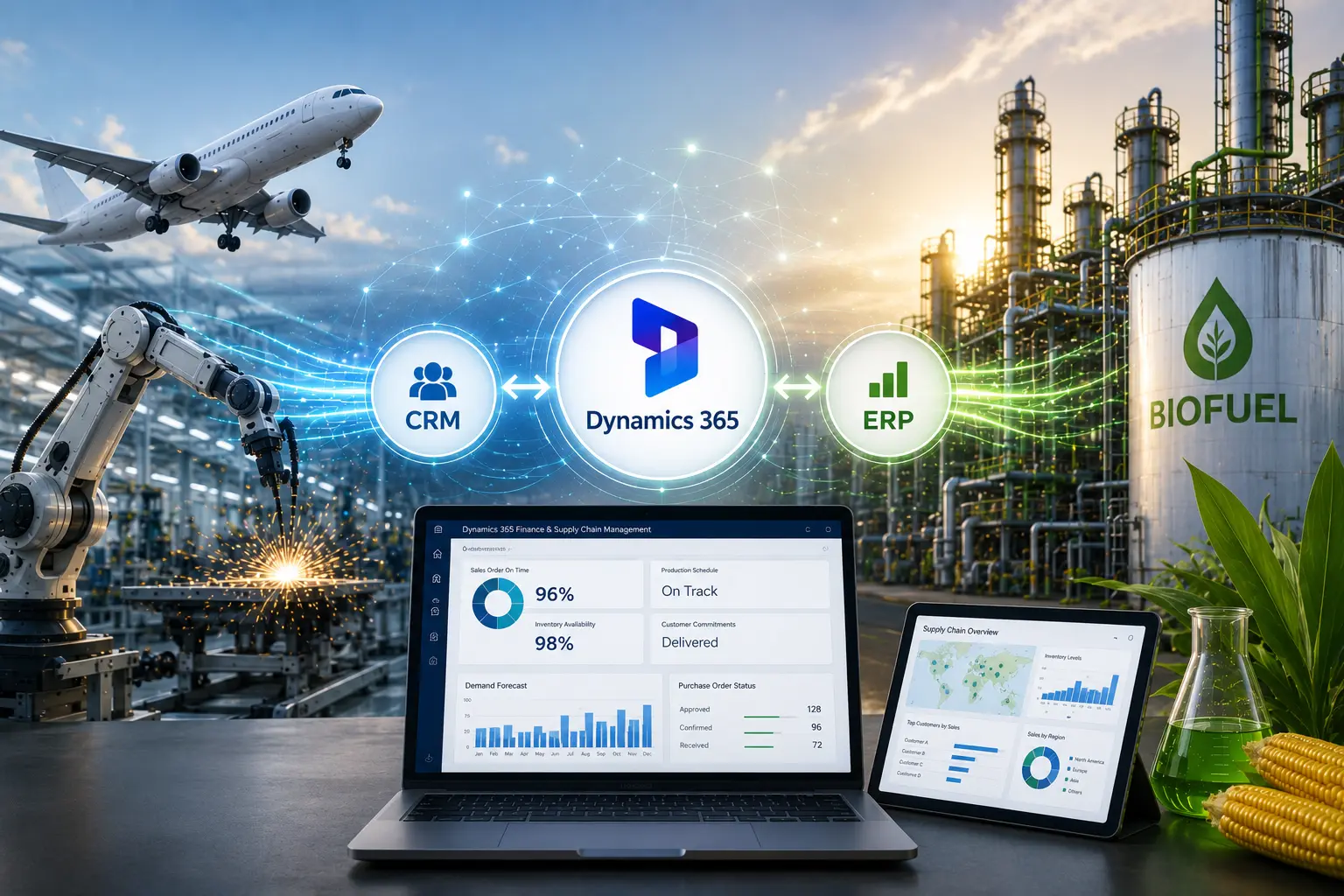
How Microsoft Dynamics 365 Finance, Supply Chain Management, CRM and Dataverse Can Connect Customer Commitments With Operational Reality
A sales team confirms a delivery date with a customer.
Operations knows that a critical component is delayed. Procurement knows that a supplier has pushed its shipment by five days. Inventory knows that only part of the required quantity is available. Finance knows that the customer's credit position has changed.
But does the salesperson know all of this while speaking to the customer?
This is one of the less visible problems inside growing manufacturing businesses.
The ERP may be working perfectly. The CRM may also be working perfectly. Yet if information between the two depends on manual updates, Excel sheets, periodic integrations, emails or people calling one another, the business is still operating with a delay between what is happening operationally and what customer-facing teams know.
For a relatively simple business, that delay may be manageable.
For an aerospace manufacturer dealing with complex products and configurations, a robotics company selling engineered equipment, or an ethanol and biofuel business managing procurement, production, inventory and dispatch simultaneously, stale information can quickly become a commercial problem.
This is where dual-write in Microsoft Dynamics 365 becomes important.
Microsoft describes dual-write as out-of-box infrastructure providing tightly coupled, bidirectional integration between finance and operations applications and Microsoft Dataverse, with data changes flowing between the environments in near real time.
The technical definition matters. But the business outcome matters more.
Dual-write can help connect what the customer has been promised with what the organization can actually deliver.
What Is Dual-Write in Microsoft Dynamics 365?
Consider a company using Microsoft Dynamics 365 Finance and Supply Chain Management as its financial and operational backbone while using Dynamics 365 Sales or other Dataverse-based applications for customer-facing processes.
Finance and Supply Chain Management may hold customer, product, inventory, vendor, pricing, financial and operational information.
Dynamics 365 Sales may contain accounts, contacts, opportunities, quotes and customer interactions.
Without an appropriate integration architecture, these can gradually become two versions of the same business.
A customer's information changes in CRM but remains different in ERP.
Sales creates a new customer but Finance does not yet have everything required to transact.
A salesperson discusses a product without current operational context.
A product or commercial change reaches one team before another.
The problem isn't necessarily that either system is wrong.
The problem is that time exists between the two truths.
Dual-write is designed to reduce that divide. Microsoft positions it for shared information that is fundamentally the same across Dynamics applications, such as customers/accounts, products/items and projects/tasks, supporting integrated scenarios such as product mastering and prospect-to-cash.
That makes dual-write more than a synchronization utility.
It can become connective tissue between the commercial and operational sides of an enterprise.
6 Reasons Dynamics 365 Dual-Write Is Attractive to Growing Enterprises
Before looking at individual industries, it is worth understanding why dual-write attracts Dynamics 365 customers in the first place.
1. It Is Native to the Microsoft Dynamics 365 Architecture
Dual-write is Microsoft's out-of-box infrastructure for connecting Finance and Operations applications with Dataverse. Microsoft provides standard table mappings and orchestration rather than requiring businesses to build every integration from scratch.
This can significantly reduce the architectural effort compared with designing an entirely custom integration layer for common Dynamics 365 business processes.
It does not mean a complex enterprise implementation can always be configured in a few hours. Environment preparation, data quality, customizations, mapping dependencies, security, testing and existing data can make a production implementation considerably more involved.
The better way to describe the advantage is:
The infrastructure is already there. The real implementation effort goes into designing the business integration correctly.
2. Near-Real-Time Synchronization Reduces the Information Gap
One of dual-write's biggest advantages is near-real-time synchronization.
If information that legitimately needs to exist across ERP and Dataverse changes, users don't necessarily have to wait for a nightly batch before the other application reflects that change.
For customer-facing teams, this can materially change the experience.
Instead of operating on yesterday's information, the organization can bring sales, service, finance and operations much closer together.
That becomes particularly valuable when a decision depends on current customer, product, order or operational information.
3. Business Validations Don't Simply Disappear at the Integration Boundary
Integration should not become a way of bypassing business controls.
If Finance and Operations contains rules that determine whether data is acceptable, synchronization has to respect the target application's business logic.
Consider a simplified example where a mandatory field or business validation is required before a customer can be accepted in Finance and Operations.
Creating incomplete information in a customer-facing application shouldn't silently create invalid ERP data.
The integration needs to identify that the transaction cannot be processed successfully, expose the failure and allow it to be corrected.
For a CFO or CIO, this is important because integration without validation merely distributes bad data faster.
4. You Can Control What Should Synchronize
Not every record needs to exist everywhere.
Dual-write mappings can use filtering so synchronization is triggered only for records meeting specified criteria. Microsoft explicitly provides guidance for adding filters to Finance and Operations or Dataverse sides of a dual-write map.
For example, an organization may decide that only a defined category of customers should synchronize rather than every early-stage record created by sales.
This ability becomes critical at enterprise scale.
The objective shouldn't be:
Copy everything everywhere.
It should be:
Make the right business information available where it is needed.
That is a very different architecture.
5. Initial Synchronization Helps Establish the Starting Point
Most dual-write implementations don't begin with two empty applications.
There may already be thousands of customers, products or other records in Finance and Operations and Dataverse.
Initial synchronization therefore becomes a critical part of the implementation.
Microsoft provides initial-sync processes for relevant maps, but architects need to pay close attention to ownership, matching, sequencing and existing data. Microsoft's product guidance, for example, warns that overlapping product records can create duplicates if existing data isn't prepared and matched correctly before synchronization.
So Initial Sync is powerful, but it shouldn't be treated as a button that magically cleans two databases.
Data readiness before synchronization is often as important as synchronization itself.
6. It Creates a Foundation for the Wider Microsoft Ecosystem
The bigger opportunity isn't simply connecting ERP with CRM.
Once Finance and Operations and Dataverse participate in a well-designed Microsoft architecture, organizations can extend processes across Dynamics 365 and the Power Platform.
That opens opportunities around workflow, applications, customer engagement, field processes and automation without repeatedly building isolated integrations.
For CIOs, this is often the strategic value of dual-write.
You are not merely solving one integration.
You are creating a more connected enterprise platform.
Why Dual-Write Is Becoming More Important for Manufacturing
Manufacturing has become increasingly difficult to manage as a sequence of isolated departments.
Customers don't care that sales works in CRM while production works in ERP.
They ask:
When will I receive my order?
Answering that accurately may require information from customer management, product configuration, inventory, procurement, production planning, quality, logistics and finance.
The more complex the product or supply chain becomes, the more dangerous stale information becomes.
This is particularly relevant across aerospace, robotics manufacturing, ethanol and biofuel, where the relationship between customer demand and operational execution can be complex.
1. Aerospace Manufacturing: When Customer Commitments Depend on Operational Reality
Aerospace manufacturing illustrates why CRM and ERP cannot remain completely separate worlds.
A commercial team may be managing an opportunity involving a component, assembly, engineered requirement or long-term customer program.
But fulfilling that opportunity can depend on material availability, approved suppliers, production capacity, product configuration, quality processes, delivery schedules and financial controls.
Imagine an account manager discussing a delivery commitment while working entirely from CRM.
CRM contains the opportunity and customer history.
But much of the information required to determine whether the promise is achievable lives in Dynamics 365 Finance and Supply Chain Management.
Without connected information, the salesperson calls planning, checks a spreadsheet, messages procurement or promises to revert later.
At scale, that becomes commercial risk.
How dual-write helps
A well-designed dual-write architecture can make relevant customer, product and operational context available across Finance and Operations and Dataverse-based processes.
Microsoft's current unified product architecture supports product masters and product variants in Dataverse, including dimensions such as size, color, style and configuration. However, product synchronization has defined data models, directions and dependencies that architects need to understand rather than simply making everything bidirectional.
For aerospace organizations, the objective is therefore not simply "connect CRM and ERP."
It is to shorten the distance between customer commitment and operational validation.
2. Robotics Manufacturing: Connecting Configure, Sell, Build and Service
Robotics manufacturers often don't sell a simple standard SKU.
A customer may need equipment configured around a particular application, payload, manufacturing environment, safety requirement or integration landscape.
That creates a lifecycle extending far beyond a CRM opportunity:
Prospect → Opportunity → Configuration → Quote → Order → Production → Installation → Asset → Service → Spare Parts → Renewal
Every hand-off introduces the possibility of information being lost.
Sales understands what the customer expects.
Engineering understands what needs to be configured.
Operations understands what can be manufactured.
Service understands what happens after installation.
Finance understands the commercial consequences.
But does each function have the right context at the right time?
Dual-write can help connect appropriate customer, product and operational data across these environments so the customer lifecycle doesn't stop when an opportunity becomes an order.
This becomes increasingly important as robotics manufacturers move from selling equipment to selling equipment + service + uptime + long-term customer value.
3. Ethanol Manufacturing: Connecting Customer Demand With Commodity-Driven Operations
Ethanol presents a different integration challenge.
Sales opportunities are influenced by operational realities such as raw-material availability, production yield, inventory, storage, logistics and commercial commitments.
Suppose a customer requests a significant quantity of ethanol.
From the CRM perspective, it is an opportunity.
From an operational perspective, it immediately raises several questions.
Do we have the available inventory?
What production is expected during the requested period?
What quantity is already committed?
Which plant should fulfil the requirement?
What will logistics cost?
Does the proposed commercial price still protect margin?
If answering those questions requires five calls and three spreadsheets, the CRM may be digital, but the sales process isn't truly connected.
Dual-write can help bring selected customer and operational information closer together while Finance and Supply Chain Management remain responsible for the operational and financial backbone.
For an ethanol company, that matters because a sale ultimately becomes a physical commitment involving quantity, quality, inventory, logistics, credit and margin.
4. Biofuel: Connecting Both Sides of the Value Chain
Biofuel businesses can be highly ecosystem-driven.
An organization may interact with feedstock suppliers, aggregators, transporters, plants, industrial customers and other partners across the same value chain.
Customer information alone therefore isn't enough.
Supplier information matters.
Product information matters.
Inventory matters.
Procurement matters.
Financial information matters.
Traceability may matter.
Microsoft's dual-write architecture supports integrated scenarios across customers, vendors, products and broader Dynamics processes.
For a biofuel organization, that makes the architecture relevant on both sides of the business.
CRM supports relationships and commercial engagement.
Finance and Supply Chain Management support procurement, inventory, financial control and execution.
Dataverse provides the common application platform on which additional customer-facing and Power Platform processes can operate.
The opportunity becomes bigger than "ERP talks to CRM."
It becomes a connected Microsoft business platform around the value chain.
5. Field Service and Asset-Intensive Manufacturing
The same model becomes particularly valuable after a manufactured product leaves the factory.
Consider a robotics manufacturer servicing equipment installed at a customer's plant.
A technician discovers that a component needs replacement.
They need to know which part is required, whether it is available, where it can be sourced and what happens if procurement is necessary.
Operations and finance simultaneously need visibility into the inventory, procurement and commercial consequences of that service activity.
This is where connecting Dataverse-based field processes with Supply Chain Management becomes strategically valuable.
Instead of service existing as an isolated activity, the customer asset can become part of a connected lifecycle spanning sales, manufacturing, inventory, procurement and after-sales service.
Is Dynamics 365 Dual-Write All Sunshine and Rainbows?
No.
And this is probably the most important section for any CIO evaluating dual-write.
The technology is powerful precisely because it tightly connects two enterprise environments.
That also means poor architecture can tightly connect two problems.
Challenge 1: Finance & Operations and CRM Teams Must Design Together
One of the biggest mistakes is treating Dynamics 365 Finance and Operations and Customer Engagement as two independent projects and deciding to "integrate them later."
Dual-write changes that.
Microsoft itself notes that developers and architects working with customer engagement applications need to understand the schema changes and collaborate with their Finance and Operations counterparts.
Customer ownership, product ownership, company structures, integration keys, validations and mappings need joint decisions.
Dual-write should begin as an architecture conversation, not an integration task at the end of implementation.
Challenge 2: Customization Is Sometimes Unavoidable
Microsoft provides standard mappings, but real businesses aren't standard.
An aerospace manufacturer may have industry-specific product attributes.
A robotics manufacturer may require additional configuration information.
An ethanol company may have commercial attributes not represented in standard mappings.
A biofuel business may have supplier or operational information specific to its value chain.
Dual-write supports custom maps and extensions to standard maps.
But every customization introduces design, testing, maintenance and upgrade considerations.
The question should therefore never be:
Can we customize this?
Usually you can.
The better question is:
Should we?
Challenge 3: The Data Models Aren't Identical
ERP and CRM systems were created to solve different business problems.
Their data models therefore aren't identical.
Product modelling is a good example.
Finance and Supply Chain Management can manage product masters and dimensions such as configuration, size, color and style. Microsoft's unified product experience maps these concepts into Dataverse and represents distinct variants appropriately, but the structure and synchronization direction still need careful consideration.
The lesson is broader than products.
Matching two fields with similar names does not automatically mean they represent the same business concept.
Data modelling has to precede synchronization.
Challenge 4: Application Lifecycle Management Needs Planning
Mappings evolve.
Applications are updated.
Customizations change.
Microsoft's guidance requires maps to be stopped before certain mapping changes can be saved, and updating map versions can require reapplying custom changes.
For businesses requiring high availability, this makes deployment planning important.
The good news is that Microsoft also provides a pause capability designed to support maintenance. While a map is paused, users can continue creating or changing records and the system can queue them for replay when synchronization resumes, subject to Microsoft's queue duration and size limits.
So this isn't a reason not to use dual-write.
It is a reason to treat dual-write as production infrastructure rather than a one-time integration configuration.
Dual-Write Is Not the Answer to Every Integration Problem
This point cannot be emphasized enough.
Do not use dual-write simply because you can.
A plant may generate millions of operational records.
Machines may produce telemetry every few seconds.
Production transactions can be extremely high-volume.
Historical information may need bulk migration.
None of these are automatically good dual-write candidates.
Microsoft positions dual-write alongside other integration approaches because different problems require different architectures.
A good architecture asks:
- Does the information genuinely need near-real-time synchronization?
- Does the record need to physically exist in both environments?
- Which application owns the information?
- What transaction volume should we expect?
- What happens when synchronization fails?
- How will conflicts be resolved?
- Is this business data or high-volume telemetry?
For example, second-by-second machine telemetry from a robotics production line generally belongs in an IoT or data architecture rather than being copied into CRM simply because integration is possible.
A useful principle is:
Synchronize business context, not every byte of operational data.
Dual-Write vs Batch, Events and Other Integration Patterns
A practical architecture can divide information into categories:
This is where an experienced Dynamics 365 architect adds considerably more value than simply enabling maps.
What Happens When Synchronization Is Interrupted?
Near-real-time integration needs a resilience strategy.
Microsoft supports pausing dual-write maps for maintenance. Changes can be queued securely and replayed after synchronization resumes, although Microsoft's current limits include a maximum one-day pause and a 1-GB queue, after which additional processing can be blocked.
For business-critical implementations, organizations should therefore establish clear answers to:
- Who monitors synchronization?
- Who receives errors?
- What happens to failed transactions?
- How quickly must a failure be resolved?
- Can business users continue working?
- How is catch-up controlled?
- How is data consistency verified afterward?
This is why we prefer to think of dual-write as a data consistency contract between applications, not simply a data pipe.
What Does Dual-Write Mean for the CIO, CFO and Sales Leadership?
For the CIO, dual-write can reduce integration fragmentation and support a more coherent Microsoft enterprise architecture.
For the CFO, the value lies in better consistency between commercial activity and operational or financial execution. Reducing manual hand-offs can strengthen process control and reduce reconciliation effort.
For the sales leader, Dynamics 365 CRM becomes more than an opportunity database. It can operate with selected operational context from the enterprise backbone.
For operations, it means fewer interruptions from customer-facing teams asking for information that already exists somewhere inside the organization.
And for the customer, it can mean something remarkably simple:
A more reliable answer.
That is ultimately where the ROI lies.
Not in synchronizing tables.
In removing organizational friction.
Frequently Asked Questions About Microsoft Dynamics 365 Dual-Write
1. What is Dynamics 365 dual-write and how does it connect Finance and Operations with CRM?
Dynamics 365 dual-write is Microsoft's out-of-box infrastructure for tightly coupled, near-real-time integration between Finance and Operations applications and Microsoft Dataverse. It allows appropriate shared business information to flow across ERP and Dataverse-based applications such as Dynamics 365 Sales.
2. Is Dynamics 365 dual-write suitable for aerospace, robotics, ethanol and biofuel manufacturing?
Yes, particularly where customer-facing processes require timely access to relevant ERP information such as customers, products, vendors, inventory or operational context. The architecture should still be designed around each industry's transaction volumes, data ownership and business processes rather than enabling every available map.
3. Is dual-write free, and does it require additional integration infrastructure?
Dual-write is provided by Microsoft as out-of-box Dynamics 365 integration infrastructure rather than requiring a separate custom integration server for the dual-write capability itself. However, organizations should not interpret this as "integration has no cost." Architecture, configuration, data preparation, testing, customizations, monitoring and ongoing support can all require implementation effort.
4. Should Dynamics 365 dual-write replace batch integrations, APIs and other integration methods?
No. Dual-write is particularly valuable for tightly coupled business data requiring near-real-time consistency between Finance and Operations and Dataverse. High-volume transactions, telemetry, bulk movements or loosely coupled integrations may be better served by other patterns. The right Dynamics 365 integration architecture often uses multiple approaches rather than forcing everything through dual-write.
5. What are the biggest risks when implementing Dynamics 365 dual-write?
The biggest risks are usually architectural rather than technical: unclear data ownership, poor-quality existing data, unnecessary bidirectional mappings, excessive customization, mismatched business concepts, high transaction volumes and inadequate ALM or failure-management processes. Successful dual-write implementations therefore require Finance and Operations, CRM/Dataverse and business teams to design the integration together.
How BaffleSol Helps Build the Right Dynamics 365 Dual-Write Architecture
At BaffleSol, our approach to dual-write starts with the business process, not the integration tool.
That distinction matters.
We work with industries where ERP processes are rarely generic. Aerospace, robotics manufacturing, ethanol and biofuel each have very different customer, product, procurement, production, inventory, service and financial models.
So our first question isn't:
Which tables should we synchronize?
It is:
Which business decisions are being delayed because ERP and customer-facing teams are working with different information?
From there, we map the complete process across Microsoft Dynamics 365 Finance, Dynamics 365 Supply Chain Management, Dynamics 365 Sales/CRM, Microsoft Dataverse and Power Platform.
We determine which system should own each record.
We identify which information genuinely needs near-real-time synchronization.
We examine existing data before Initial Sync.
We identify where Microsoft's standard dual-write mappings can be retained and where business-specific customization is justified.
We determine which high-volume processes should not use dual-write.
And we design error handling, monitoring, deployment and ongoing governance as part of the solution rather than treating them as post-go-live concerns.
For aerospace, that may mean connecting customer and product information with complex manufacturing operations.
For robotics manufacturers, the connected process can extend from opportunity and configuration through production, installed assets and service.
For ethanol businesses, it can help reduce the information gap between customer demand, production, inventory and commercial execution.
For biofuel organizations, the architecture can span customers, suppliers, procurement, inventory, logistics and finance.
That industry understanding is important because dual-write isn't successful merely when two databases synchronize successfully.
It is successful when two sides of the organization stop behaving like two different businesses.
CRM understands what operations can deliver. Operations understands what the customer has been promised. Finance understands the commercial consequence. And the customer receives a faster, more reliable answer.
That is the real business case for Microsoft Dynamics 365 dual-write.




.svg)