


Empowering
Data Sovereignty, DPDP Act Enforcement, and the Rise of Microsoft Dynamics as a Governance System
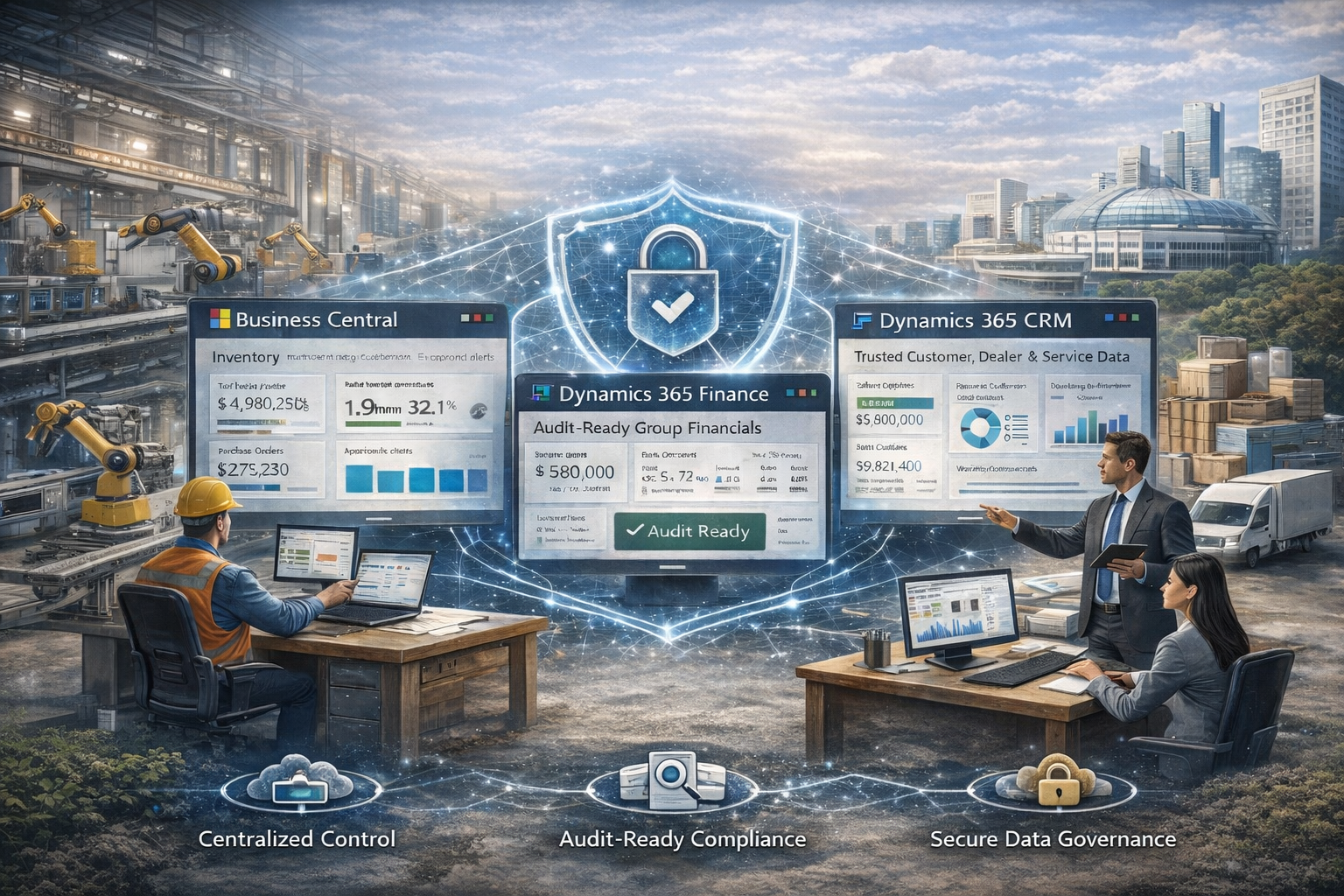
Why Business Central, Finance, and CRM Are Becoming the Trust Backbone for Manufacturing-Led Enterprises
Introduction: From Digital Transformation to Digital Trust
For much of the last decade, digital transformation meant speed and scale.
Manufacturers modernised ERP systems, digitised plants, integrated suppliers, adopted CRM for dealers and customers, and moved infrastructure to the cloud. Success was measured in throughput, automation, and efficiency.
That definition of success is now incomplete.
As Lieutenant General Nair articulated, this decade is no longer about building digital infrastructure — it is about building digital trust.
Trust today is measured through hard questions that boards, regulators, and customers increasingly ask:
- Where does sensitive data actually live?
- Who can access it across plants, offices, and partner ecosystems?
- How is that access governed, logged, and audited?
- How does data move across systems, cloud regions, and national borders?
With India’s Digital Personal Data Protection (DPDP) Act entering its enforcement phase — and with global precedents such as GDPR already reshaping accountability — organisations are entering a new reality.
In this reality, system architecture itself becomes proof of compliance.
This is where Microsoft Dynamics has fundamentally changed roles.
Microsoft Dynamics is no longer just business software.
It is becoming the trust, compliance, and governance backbone of modern manufacturing, distribution, and customer-centric enterprises.
WHAT’S CHANGING: Enforcement, Accountability, and System Design
DPDP Act: Compliance Moves from Policy to Platform
The DPDP Act marks a structural shift in how compliance is evaluated.
Earlier compliance models focused on:
- Privacy notices and consent language
- Internal SOPs and declarations
- Manual checks and post-facto audits
The enforcement-led model focuses instead on:
- How systems are configured
- Whether access controls are enforced
- If accountability is traceable at a system level
For manufacturing organisations, this shift is critical because sensitive personal data exists far beyond customer records:
- Employee and contract labour data across plants
- Attendance, shift, and contractor records
- Dealer and distributor master data
- Warranty, service, and after-sales customer information
- Financial and statutory records tied to individuals
Regulators will not ask only whether data is protected.
They will ask how Microsoft Dynamics enforces that protection by design.
Multi-Location and Cross-Border Data Flows Increase Risk
Manufacturing enterprises rarely operate from a single location. They typically manage:
- Multiple plants across states or countries
- Centralised finance or shared services centres
- Distributed sales, dealer, and service networks
Data flows continuously between:
- Dynamics 365 CRM (sales, dealers, service)
- Dynamics 365 Business Central (operations, inventory, procurement)
- Dynamics 365 Finance (group-level accounting and compliance)
Boards are now being asked:
- Where does employee and dealer data reside?
- Which Microsoft Dynamics environment is the system of record?
- How is access governed across plants, vendors, and partners?
These are architecture questions, not legal footnotes.
AI Adoption Raises Both Data and Cost Governance Stakes
Manufacturers are increasingly adopting AI-driven capabilities such as:
- Predictive maintenance
- Demand forecasting
- Production planning optimisation
- AI-assisted sales and service insights
AI introduces two compounded risks:
- It consumes large volumes of sensitive operational and personal data
- It creates cost volatility if workloads are not centrally governed
As a result, data governance and AI cost governance are now inseparable.
Microsoft Dynamics, operating within the Microsoft ecosystem, provides a controlled surface where AI operates inside defined trust boundaries, rather than across disconnected tools.
Digital Transformation Roadmaps Are Now Governance Roadmaps
What was once a “cloud migration plan” has evolved into:
- Identity and access governance strategy
- Data residency and sovereignty planning
- Integration and vendor risk control
- Cost management for AI and analytics workloads
Cloud adoption without governance is no longer innovation — it is exposure.
WHY MICROSOFT DYNAMICS IS CENTRAL FOR MANUFACTURING ENTERPRISES
Manufacturing Data Is Broader Than Customer Data
Manufacturing organisations manage complex, interconnected data sets:
- Employees, contract labour, and shift workers
- Dealers, distributors, and channel partners
- Customers, warranty holders, and service recipients
- Suppliers and logistics partners
- Financial, statutory, and audit records
When Dynamics 365 CRM integrates with Business Central and Dynamics 365 Finance, this data converges into a single governance layer.
This convergence is exactly why Microsoft Dynamics becomes the focal point for compliance — and also the strongest place to enforce it.
Fragmented Systems Multiply Risk Across the Value Chain
Many manufacturers still operate with:
- CRM disconnected from ERP
- Plant-level systems isolated from finance
- Data exported into spreadsheets
- Third-party tools accessing data without visibility
This fragmentation creates:
- Duplicate copies of personal data
- Inconsistent access rights across plants
- Weak auditability during inspections
Under DPDP and GDPR-style enforcement, fragmentation itself is treated as a compliance failure, even in the absence of a breach.
Microsoft Dynamics reduces this exposure by acting as a central, governed platform.
Audits Now Examine System Design, Not Just Records
Modern audits increasingly ask:
- Who can access employee and contractor data across plants?
- How is dealer and distributor data governed in CRM?
- Can finance trace every transaction to a controlled source?
- How are role changes enforced across operations, sales, and finance?
These questions require Microsoft Dynamics role design, security configuration, and audit trails, not manual explanations.
HOW MICROSOFT DYNAMICS WORKS AS A GOVERNANCE SYSTEM
Business Central: Governed Operations for Manufacturing
Microsoft Dynamics 365 Business Central governs:
- Inventory, warehouse, and production data
- BOMs, procurement, and vendor records
- Operational approvals and workflows
All within a role-based, audit-ready system that enforces consistency across plants and locations.
Dynamics 365 CRM: Trusted Customer, Dealer, and Service Data
Dynamics 365 CRM manages:
- Dealer and distributor master data
- Customer interactions, contracts, and service history
- Warranty and after-sales records
Critically, this data is not isolated.
It is governed alongside finance and operations, reducing leakage and duplication.
Dynamics 365 Finance (FinOps): Enterprise-Grade Accountability
Microsoft Dynamics 365 Finance enables:
- Multi-entity and multi-location financial governance
- Segregation of duties and approval hierarchies
- Centralised compliance and statutory reporting
- Audit-ready financial controls
For large manufacturing groups, FinOps becomes the system of accountability.
The Microsoft Cloud Foundation
Underpinning everything is Microsoft Azure, providing:
- Data residency and sovereignty controls
- Encryption across the data lifecycle
- Centralised identity and access management
- Cost controls for AI and analytics workloads
This foundation is why Microsoft platforms are among the most trusted globally under GDPR — and increasingly under DPDP.
WHAT MANUFACTURING ENTERPRISES MUST DO NEXT
- Reframe Microsoft Dynamics as a governance platform, not just ERP
- Unify CRM, Business Central, and Finance under one trust boundary
- Design security and access with enforcement in mind
- Align AI adoption with data and cost governance
FAQs: Questions CXOs, Auditors, and IT Heads Are Actually Asking
Is Microsoft Dynamics DPDP-compliant out of the box?
Microsoft Dynamics provides the controls, audit trails, and security architecture required for DPDP compliance. Actual compliance depends on correct configuration, role design, and governance practices.
How does Microsoft Dynamics help during audits or inspections?
Dynamics provides system-level audit trails, role-based access logs, and traceability across CRM, operations, and finance — enabling auditors to validate controls directly in the system.
Does Business Central support manufacturing-specific data governance?
Yes. Business Central governs inventory, production, procurement, and vendor data with role-based access and approvals, making plant-level data auditable and compliant.
When should a manufacturer move from Business Central to Finance (FinOps)?
When operations span multiple entities, geographies, or require advanced segregation of duties and statutory control, Dynamics 365 Finance becomes necessary.
How does CRM integration impact data protection?
CRM integration ensures customer and dealer data is governed within the same security and audit framework as finance and operations, reducing uncontrolled data replication.
Is Microsoft Dynamics suitable for regulated and global operations?
Yes. Microsoft Dynamics, running on Azure, is built to meet global standards such as GDPR and supports data residency, identity governance, and audit requirements.
FINAL TAKEAWAY: Microsoft Dynamics as the Trust Backbone
For manufacturing-led enterprises, digital trust is no longer optional.
Between DPDP enforcement, global data protection norms, distributed plants, dealer networks, and AI-driven operations, trust must be engineered into systems — not documented after the fact.
Microsoft Dynamics 365 Business Central, Dynamics 365 Finance, and Dynamics 365 CRM — running on the Microsoft cloud — provide exactly that:
- Centralised control
- Audit-ready compliance
- Secure, scalable innovation
In the coming decade, manufacturing competitiveness will be defined not just by efficiency, but by trust.
And Microsoft Dynamics will be the system through which that trust is demonstrated.
.png)



.svg)